Scenic USA - Kansas
Each day Scenic USA presents a different and interesting photo feature from somewhere in
the United States. Chosen from a wide variety of historic sites, city scenes, backcountry
byways, points of interest and America's best parklands, this site offers the viewer hundreds
of unique vacation destinations and photographic subjects. Each feature is coupled with a
brief explanation. For further detailed information, links to other sites are provided, however
these links should not be considered an endorsement.

Other nearby
Points of Interest
Hillsboro Cove, Marion Reservoir
Tallgrass Praire National Preserve
At no extra cost to you, using this link helps support Scenic USA when you shop on-line at Amazon
Mennonite Settlement Museum
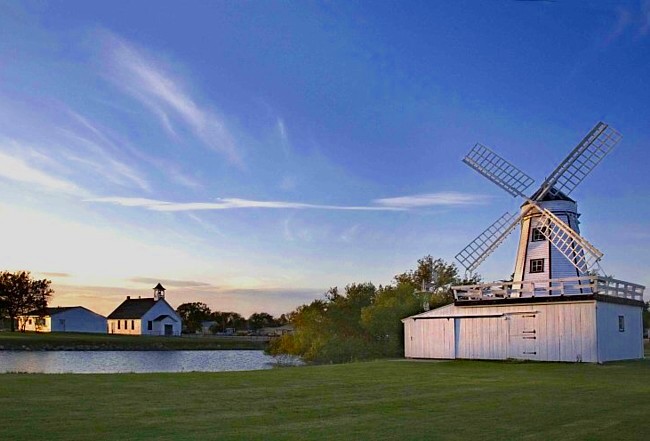
| Photo by Neil Marcus Neil's PBase Gallery |
Even as late as the mid 1800s, many Americans still referred to the land between the Appalachian Mountains and the Mississippi River as the West. To the best of their knowledge, the land beyond the Mississippi was an inhospitable plain controlled by bands of Pawnees, Kiowas and Sioux. What followed in the 1840s was an incredible transformation. Following three major routes, (Oregon, Santa Fe and Mormon trails, plus a shorter California spur) the lands in eastern Texas, the Sacramento Valley and Willamette Valley were opened up to more than 300,000 pioneers, miners, farmers and 19th century entrepreneurs.
At first, the Great Plains area was viewed as a formidable barrier, and in crossing, it became part of the journey that simply had to be endured. Over time, some of the well watered sites in northern Missouri, eastern Kansas and Nebraska began to attract groups of ethnic settlers. The Mennonite Settlement Museum celebrates these groups of Eastern European Mennonites who arrived in Hillsboro, Kansas, in 1870. These refugees from Russia and Poland were instrumental in building 14 villages in east-central Kansas.
Here on the Great Plains a fickle Cottonwood River was not reliable for water power, but prairie winds were strong enough to power a windmill in the village of Gnadenau. Recreated from a 1904 photograph, the mill was built by Dr. Richard Wall. Here at the museum, visitors may experience late 19th century living on the Kansas prairie, along with this recreation of the 1876 Jacob Friesen Flour Mill.
Area Map
Copyright © 2010-14 Benjamin Prepelka
All Rights Reserved