|
The lighthouse idea, more than two thousand years old, is found among the final chapters of ancient Egyptian history. On the offshore island of Pharos, a massive lighthouse signaled the port of Alexandria in 280 BC. Some of America’s first lighthouses were built in the early 1700s, helping to establish a fledgling maritime economy in the New World. Marking harbors and inlets, and warning mariners of dangerous shoals and reefs, lighthouse towers became commonplace during the 17th Century. Lighthouse designs took on many different styles and shapes, from the first wooden towers to breakwater lights and specialty light-stations with complex screw-pile designs.
Over the years lighthouse construction improved dramatically. Towers were strengthened, keeper’s quarters were expanded, and steam powered fog signals were added. But the greatest improvement came to broadcasting the light beam itself. Called a genius by his French play pals, Augustin Fresnel (fray-NELL) spent his adult life understanding the theories of light and conducting studies in optical phenomena. Although reflector systems were a vast improvement in broadcasting light, it was Fresnel’s lens that would capture more than 80 percent of the light source. It was a modern miracle compared to the meager 17 percent efficiency of the reflector. While in his mid 30s Fresnel created the first lighthouse lens design, using an array of hundreds of glass prisms to refract and magnify the light into a single narrow beam. This concentrated light could be seen much farther than a typical lighthouse of the early 1800s. Installed on the Cordouan Tower in France, Fresnel’s light was seen for over 20 miles from its point on the Gironde River. Fresnel went on to develop a series of eleven lenses, all with various focal lengths for different applications. Ranging from the smallest (11) to the largest (1), the sixth-order lens, measuring about 17 inches high and supporting a range of 5 miles, was the smallest used on the Great Lakes. The largest first-order Fresnel lens could cast its beam a distance of 26 miles. 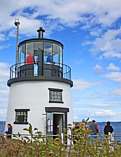 Because of the great expense, it took another 30 years before America embraced the Fresnel lens. Because of the great expense, it took another 30 years before America embraced the Fresnel lens.
Here at Owls Head Lighthouse in Rockland Harbor, Maine, visitors get a good look at a 4th order Fresnel lens that was installed in 1856. The smaller fourth order lens, measuring two and a half feet tall, was limited in distance and visibility. Weighing between 440 and 660 pounds, this lens was used primarily for lakes and harbors. By the 1870s, nearly all lighthouses in America had adopted the Fresnel lens. Although many lighthouses today still use original Fresnel lenses, many have been replaced with modern optics and make wonderful maritime museum displays.
|