Scenic USA - West Virginia
Each day Scenic USA presents a different and interesting photo feature from somewhere in
the United States. Chosen from a wide variety of historic sites, city scenes, backcountry
byways, points of interest and America's best parklands, this site offers the viewer hundreds
of unique vacation destinations and photographic subjects. Each feature is coupled with a
brief explanation. For further detailed information, links to other sites are provided, however
these links should not be considered an endorsement.

Other nearby
Points of Interest
Upshur County Historical Society & Museum
West Virginia State Wildlife Center
At no extra cost to you, using this link helps support Scenic USA when you shop on-line at Amazon
Fidler's Mill
| Photo by Amanda Haddox Amanda Haddox Photography Inset photo courtesy Upshur County Convention and Visitors Bureau |
Serving its residents for well over a century, this 19th century Upshur County landmark is located south of Buckhannon on Heaston Ridge Road in Arlington. Still standing along the banks of the Little Kanawha River on a section called Arlington Falls, the mill once provided dual services for grinding grain and carding wool. 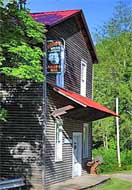 While many of these historic structures have vanished during the past century, Fidler’s Mill and its machinery remain in excellent condition. Metal gears, wooden chutes, hoppers, and leather belts still bear patent dates of 1779 through the late 1800s.
Arriving from Fluvanna County, Virginia, William Fidler purchased the mill property in 1848. With the help of slaves, Fidler enlarged the original mill built in 1821 by Daniel Peck. The foundation was constructed of stone and the post and beam frame was built with yellow poplar. After the death of son William Martin in 1901, E.G. Wilson purchased the mill. Wilson further enlarged the building, adding the upper stories covered in the horizontal clapboards as seen today. Having financial difficulties over the next a few years, the property was sold back to the Fidler family, with sons and grandsons contining milling operations until the mid 1900s.
Power for the mill came from an upstream mill pond, feeding a wooden mill race that directed water to a 20 foot overshot wheel. The mill had enough power to run two milling stations, one to grind corn, and to other to produce finer wheat, buckwheat and rye flours. A ramshackled sawmill also utilized waterpower from the millrace, but was relocated downstream by the early 1900s. Upper story mill machinery would also be used to pick and card wool. The wool was fluffed, spun into 2 foot long, 1/2 inch thick rolls, ready for the spinning wheel. Fidler’s Mill was also a community gathering place, offering the perfect dance floor on special occasions and holidays.
Area Map
Copyright © 2010-14 Benjamin Prepelka
All Rights Reserved